
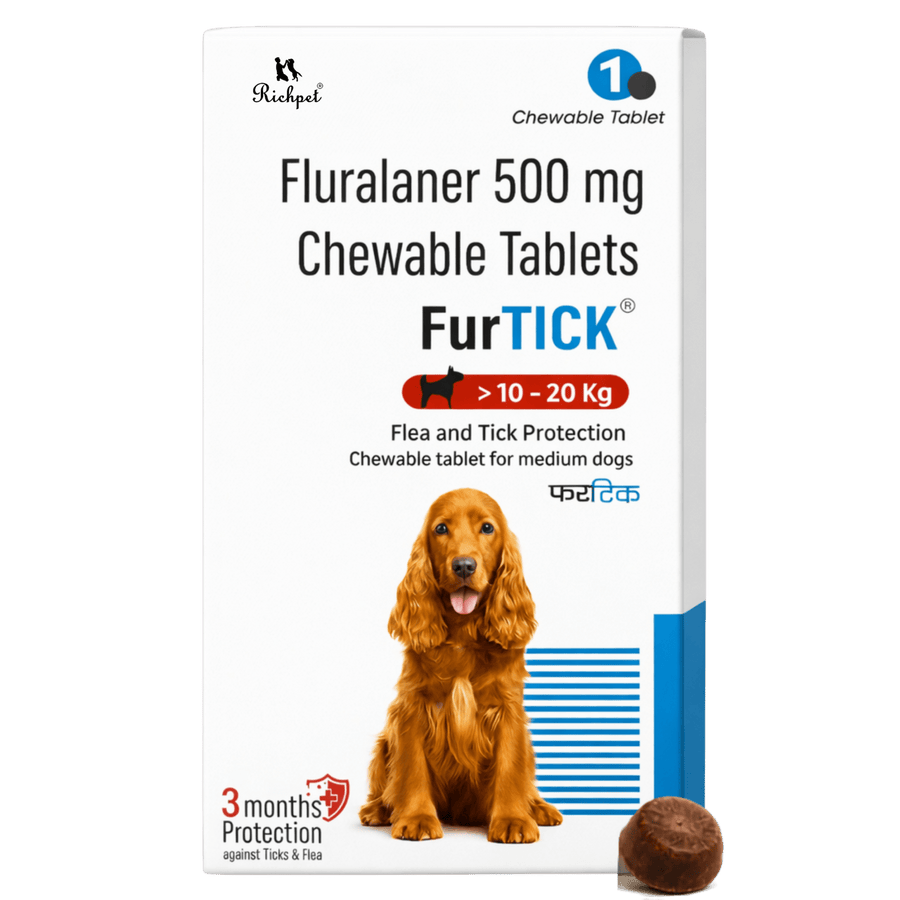
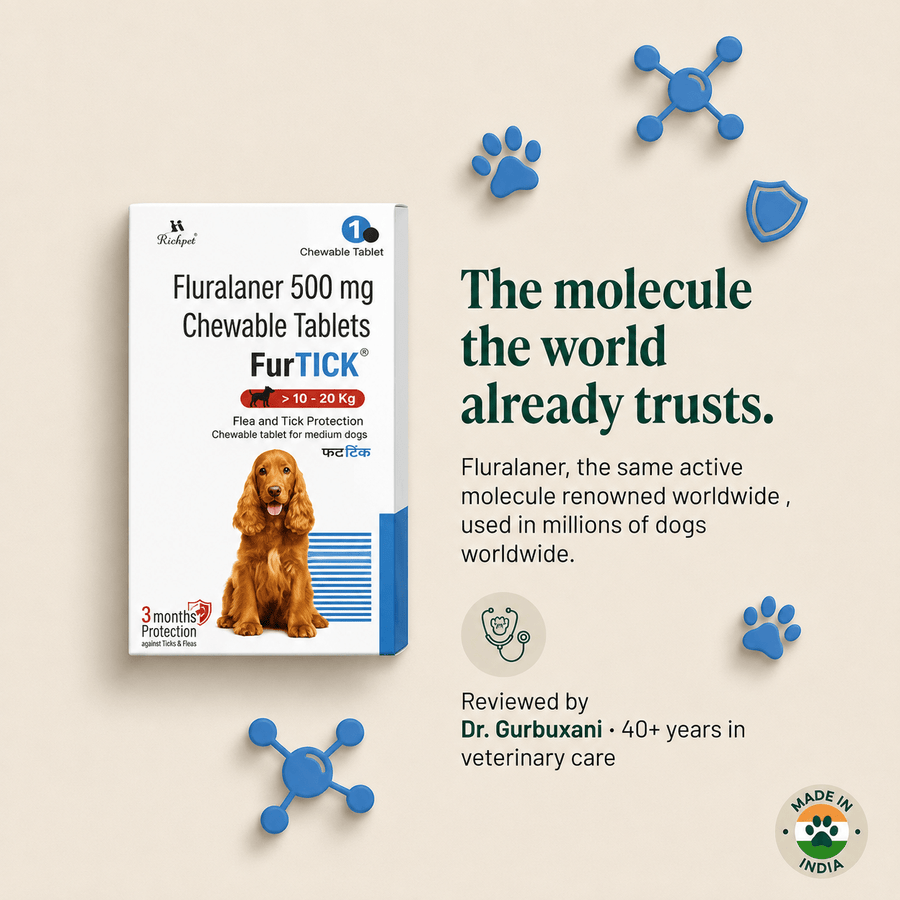





90-Day Tick Defense · Chew tablet
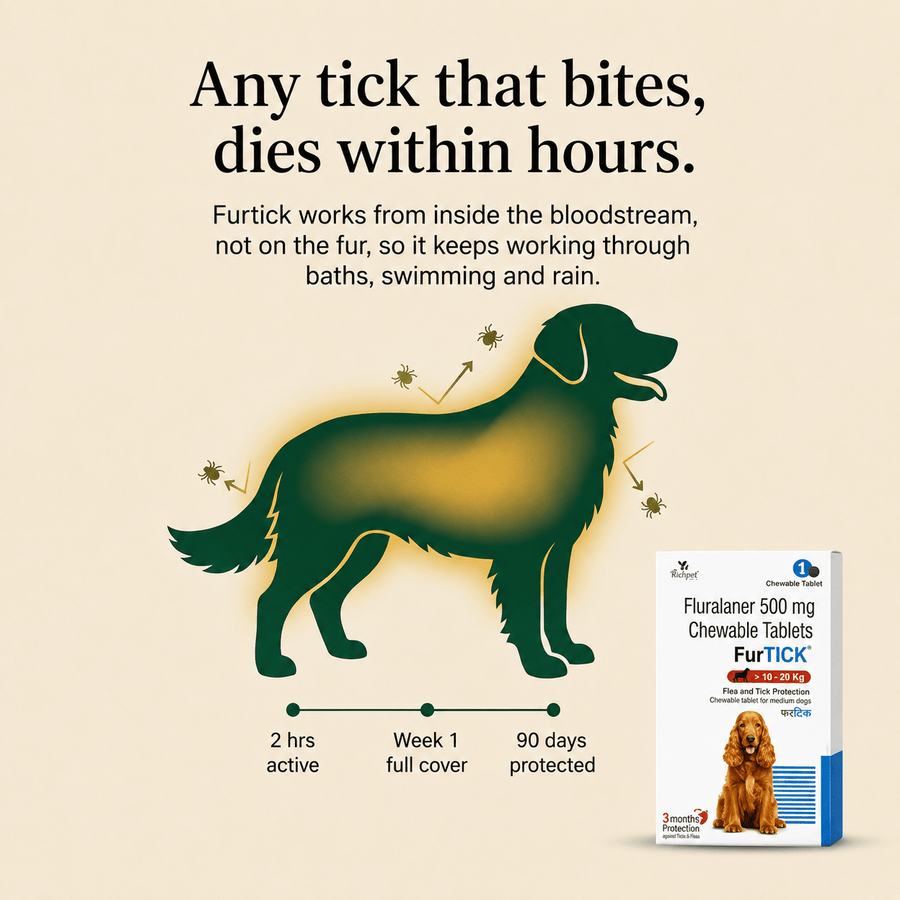
One flavored chew tablet. For the next 90 days, any tick, flea or mite that bites your dog encounters fluralaner in the bloodstream — and dies.
Protection that works through monsoon walks, swimming, and rolling in grass because it operates from inside the blood, not on the surface of the coat.
For Cocker Spaniel, Shih Tzu, Husky..
Symptoms of tick fever in dogs
The 8 signs every Indian pet parent should recognise, and the 24-hour window that decides recovery.
The first symptoms of tick fever in dogs are a high fever above 103°F, sudden lethargy, loss of appetite, and pale gums, usually 1 to 3 weeks after an infected tick bite. Left untreated, tick fever damages red blood cells, causes anaemia, and can be fatal. Caught within the first few days of symptoms, most dogs recover fully.
In India, tick fever is caused mainly by two pathogens carried by the brown dog tick: Babesia (which attacks red blood cells) and Ehrlichia canis (which attacks white blood cells and platelets). Monsoon months are when cases spike, and even indoor apartment dogs are at risk because the brown dog tick survives in carpets, sofas, and bedding.
What tick fever actually is
Tick fever is an umbrella term for tick-borne infections that enter your dog's bloodstream when an infected tick bites and feeds. The two most common causes in India are Babesiosis, caused by the protozoa Babesia canis and Babesia gibsoni, and Ehrlichiosis, caused by the bacteria Ehrlichia canis.
Babesia enters red blood cells and destroys them, causing anaemia. Ehrlichia attacks white blood cells and platelets, causing weakness and internal bleeding. Both are transmitted by the same carrier: the Rhipicephalus sanguineus, better known as the brown dog tick.
All breeds, ages, and both genders are equally at risk. Indoor dogs are not exempt. The brown dog tick is the one tick species that thrives inside Indian homes, hiding in carpets, sofas, and cracks in flooring.
The 8 symptoms every parent should know
These are the signs Indian vets see most often. Some appear early, others show up as the disease progresses. Two or more of these together after known tick exposure is reason enough to book a vet visit the same day.
- High fever, above 103°F. A dog's normal temperature is 101 to 102.5°F. Ears, belly, and paws feel warmer than usual.
- Sudden lethargy. Your dog sleeps more, refuses walks, seems emotionally flat, and does not respond to favourite treats.
- Loss of appetite. Skipping meals for more than 24 hours, or eating a fraction of the usual amount.
- Pale gums. Healthy gums are salmon pink. Pale, white, or yellow gums point to anaemia and are a red flag.
- Dark or reddish urine. A sign that red blood cells are being destroyed, common in babesiosis.
- Swollen lymph nodes. Feel under the jaw, in front of the shoulders, and behind the knees. Firm, enlarged nodes mean the immune system is fighting an infection.
- Nose bleeds or unusual bruising. Ehrlichia lowers platelet counts and can cause pinpoint red spots on the gums, belly, or inside the ears.
- Joint pain or limping. Some dogs walk stiffly, refuse stairs, or hesitate to jump.
Different weight? See all Furtick sizes
How tick fever progresses in a dog
Tick fever does not appear the day of a bite. There is a window between infection and symptoms, and understanding it helps you catch the disease early.
| Stage | What happens |
|---|---|
| Day 0 | Infected tick attaches. Transmission needs 24 to 48 hours of feeding. |
| Week 1 to 3 | Pathogens multiply silently. Your dog looks normal. |
| Acute stage | Fever, lethargy, loss of appetite, swollen lymph nodes. This is the best window to treat. |
| Subclinical | Symptoms fade but the pathogen stays in the body. Dog looks fine. |
| Chronic stage | Anaemia, uncontrolled bleeding, organ damage. Recovery becomes much harder. |
When it becomes an emergency
Some symptoms cannot wait until morning. If your dog shows any of these, treat it as an emergency and get to a vet immediately.
Tick fever will not resolve safely on its own. The difference between a dog that recovers fully and one that does not is often 24 to 48 hours of early veterinary care.
How vets diagnose and treat it
Diagnosis: a complete blood count (CBC), blood biochemistry, and a PCR or qPCR test are the standard. The PCR test identifies the specific pathogen so treatment can be targeted. A blood smear may also be used to spot the parasites directly inside red blood cells.
Treatment for Ehrlichia: a course of antibiotics, typically doxycycline, for 3 to 4 weeks. Caught in the acute stage, most dogs recover fully.
Treatment for Babesia: antiprotozoal medication chosen based on the Babesia species. Dogs infected with Babesia can remain lifelong subclinical carriers even after recovery.
Supportive care: IV fluids, liver and kidney support, and in severe anaemia, blood transfusion. Expect a treatment cost between ₹5,000 and ₹25,000 depending on severity and city.
The 24-hour window that prevents tick fever
A tick has to stay attached and feeding for 24 to 48 hours to transmit Babesia or Ehrlichia. That window is the entire prevention playbook.
Modern oral chewables built around the molecule Fluralaner live in your dog's bloodstream. When a tick bites, it ingests Fluralaner within hours, and dies before it can pass on the disease. This is why a Fluralaner chewable is more reliable than a shampoo, powder, or spot-on for a dog exposed to Indian tick pressure.
What Richpet families say
"Lucy's non-stop scratching was breaking my heart. We tried everything, but nothing worked. Then, I gave her Richpet, and the next day, the scratching just stopped."
"I don't have to hide this in a piece of cheese. My dog Sheru just eats it. He honestly thinks it's a treat. And I feel good about the ingredients."
"Our vet was the one who told us about Richpet. Bella's coat is healthier, and she's got way more energy now. No fight to get her to take it."
Frequently asked questions
The questions Indian pet parents ask us most.
What are the first symptoms of tick fever in dogs?
The first symptoms of tick fever in dogs are fever above 103°F, sudden lethargy, and loss of appetite, usually appearing 1 to 3 weeks after an infected tick bite. Pale gums, dark urine, and swollen lymph nodes under the jaw follow. If you spot two or more of these signs after tick exposure, see a vet the same day.
How long does it take for tick fever to show in a dog?
Tick fever symptoms usually appear 1 to 3 weeks after an infected tick bite. The tick itself needs to stay attached for 24 to 48 hours to transmit Babesia or Ehrlichia into your dog's bloodstream.
Can tick fever kill a dog?
Yes, untreated tick fever can be fatal. Severe cases cause anaemia, organ damage, and internal bleeding. Caught early, most dogs recover fully with antibiotics and supportive care, which is why the first symptoms matter.
Is tick fever contagious to other dogs or humans?
Tick fever does not spread directly from dog to dog through contact. It spreads when an infected tick bites a healthy dog. Handle tick removal with gloves and do not crush ticks with bare hands.
How can I prevent tick fever in my dog in India?
The most reliable prevention is a Fluralaner-based oral chewable every 12 weeks, combined with daily tick checks and weekly cleaning of bedding. Furtick delivers 90 days of protection in a single chew, working from inside the bloodstream so ticks die before they can transmit disease.
How is Furtick different from the imported chewable my vet prescribes?
Furtick contains Fluralaner, the exact same active molecule as the prescription-only imported chewable, at the same 25 mg per kg dose. The difference is that Furtick is manufactured in India, ships without a prescription, and is priced for Indian pet parents. Over 10,000 families and their vets already trust Furtick.
Stop tick fever before it starts
One Furtick chew. 90 days of protection. The exact molecule vets prescribe, at Indian D2C pricing.
Shop Furtick →
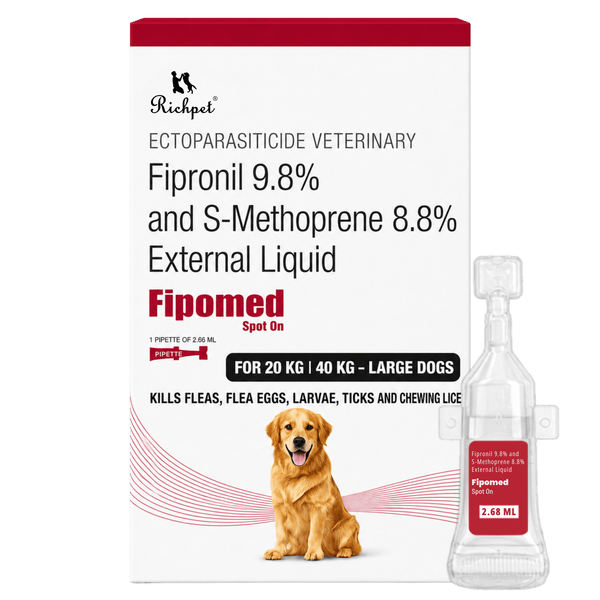


Monthly Tick & Flea · Spot-On Pipette ·2.68ml
Fipronil disrupts the nervous system of any flea, tick or lice that bites — not repelling them, killing them. Applied once at the back of the neck, it distributes through the coat's natural oils and stays active for 30 full days through baths, rain and outdoor walks.
One pipette. Nothing to remember for 30 days after.
For Labrador, Golden Retriever, German Shepherd..


Monthly Parasite Defense · Selamectin Spot-On · Cats & Kittens
Ear drops treat what's visible. Ear mites live deeper — in the canal where drops don't consistently reach — which is why the problem keeps returning.
Selamectin is absorbed through the skin at the back of the neck, enters the bloodstream, and reaches the mites systemically.
Applied at the neck, it treats the ear. One monthly application also controls fleas, roundworms, hookworms, and prevents heartworm from any mosquito that enters the home.
One drop at the back of the neck. Fleas, ear mites, roundworms, hookworms, heartworm prevention. Thirty seconds, once a month.
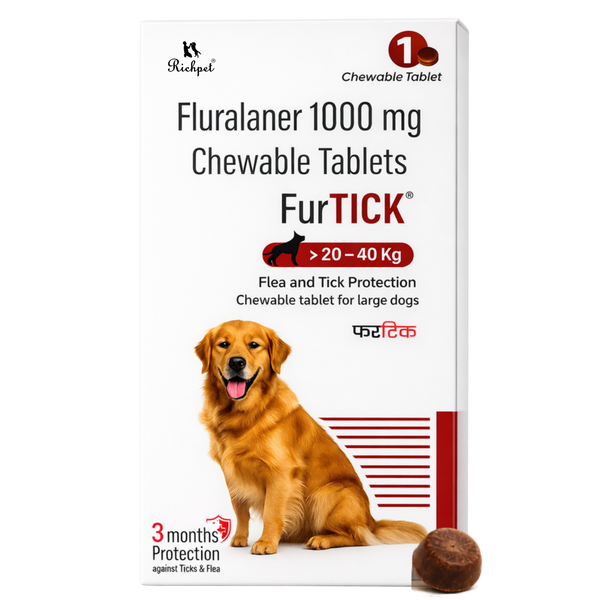


90-Day Tick Defense · Chew tablet
One flavored chew tablet. For the next 90 days, any tick, flea or mite that bites your dog encounters fluralaner in the bloodstream — and dies.
Protection that works through monsoon walks, swimming, and rolling in grass because it operates from inside the blood, not on the surface of the coat.
For Labrador, Golden Retriever, German Shepherd..



90-Day Tick Defense · Chew tablet
One flavored chew tablet. For the next 90 days, any tick, flea or mite that bites your dog encounters fluralaner in the bloodstream — and dies.
Protection that works through monsoon walks, swimming, and rolling in grass because it operates from inside the blood, not on the surface of the coat.
For Indie, Pomeranian, Beagle..